
Keeping a “Memory List”
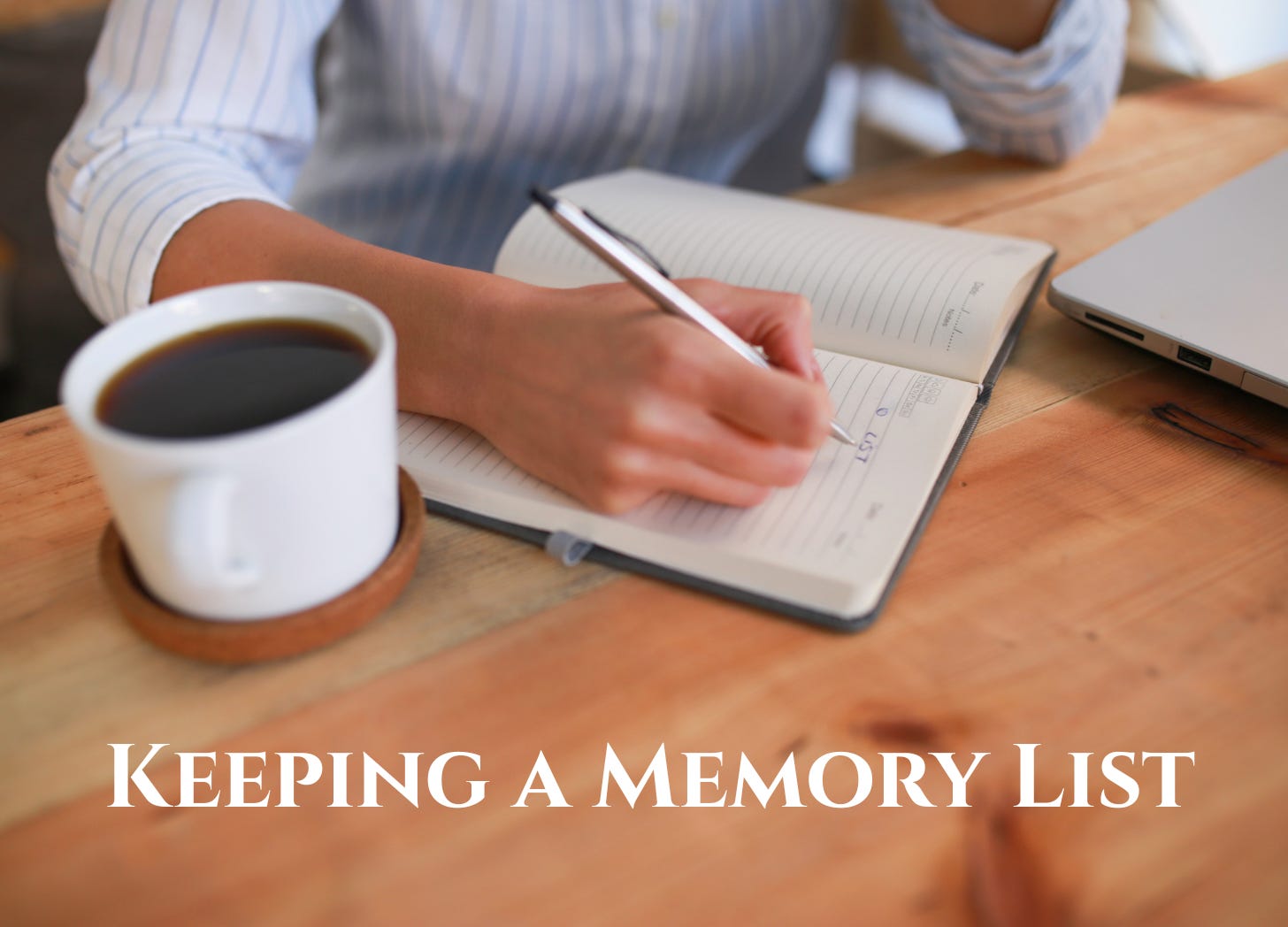
“Memory List” sounds so much classier than “Brain Dump” which is the phrase I use when I am coaching clients (and in my writing courses).
Once you have determined the period of time you want to write about, the first thing I have people do is a brain dump. That is, take an hour or so, a pad of paper and pen, and I highly recommend a cup of coffee or tea, or a glass or two of wine (yeah, you know which I choose, right?) and just list out all the things that pop into your mind about that period of time.
Things like:
How old you were
How you felt about yourself at the time
Who did you admire? Who intimidated you?
Where you lived
Who you lived with
Did you have a significant other, best friend, favorite pet?
Your favorite outfit
Something someone wore that you always think of when you think of them
What events happened in that time period in your life
What local, national or international events happened in that time period
Were you in school? Working a job? Happily or unhappily taking time off?
You want to keep these short—two or three words, a line, just so you don’t lose the idea. But you also want them to be specific enough that you can figure out what you meant when you wrote it down. (This happens more frequently as you get older. Just sayin.)
Most people can scribble down 15 or 20 items right off the bat and then they get stuck. Sit with it because some of your best memories come with a bit of relaxed thought.
Also, don’t judge: You’re just writing down ideas. The time to decide whether or not to use them, whether or not they’re important will come later. There are no bad ideas in a brain dump—you’re just getting stuff out of your head.
Keep that list handy—you’re going to add to it as more things come back to you!
Some of the items you write down might become entire chapters in themselves. You can then make a memory list or brain dump for the individual chapters.
All of this gives you scenes to write about. You don’t have to write your memories in order, but you may find an organic structure forming as you pile up your stories. (Best case scenario.) More often, you will build bridges between your stories to create a smooth narrative. But for now, for this particular exercise, you are just jotting down all the memories that are hiding in your brain so you don’t lose them.
At another time, if you are still in touch with others from that time period, ask them what they remember. What’s REALLY interesting is asking people who were there how they remember something. They may bring up something you’ve forgotten or they may remember the event in an entirely different way. Then you get to decide which way you want to write it.
Here’s a clue: It’s your memoir which means it’s your memory that gets chronicled.
Need help writing your memoir? Spill the Ink is a self-paced online course that takes you from idea to published book. Find out more here: SPILL THE INK